
Mystery Unraveled◆ Revealing the Fragility of Human Nature

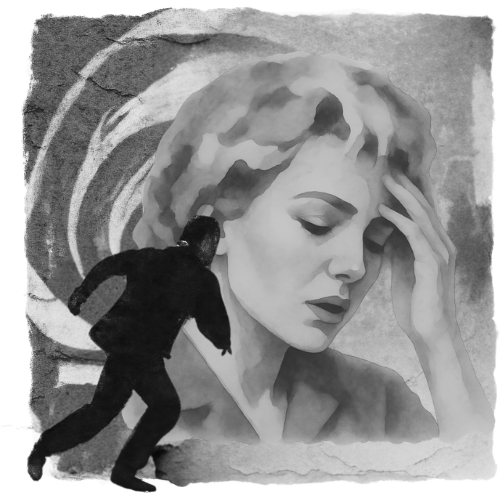
Chunichi Shimbun, Morning Edition, October 20, 2006
Vertigo (1958, USA)
As one mysterious event follows another and the truth gradually comes to light, the film quietly reveals the fragility of the human condition. Alfred Hitchcock's masterpiece Vertigo is a classic example of psychological suspense at its finest.
The protagonist, John "Scottie" Ferguson (James Stewart), is a police detective. While chasing a suspect across rooftops, he suffers a panic attack brought on by his fear of heights. A fellow officer who tries to save him falls to his death. Overwhelmed with guilt and despair, Scottie resigns from the police force.
Soon afterward, an old friend asks him to follow his beautiful wife, Madeleine (Kim Novak). He explains that she appears to be possessed by the spirit of her great-grandmother, behaving like a sleepwalker and wandering aimlessly.
As Scottie tails her, Madeleine visits places connected with her ancestor before suddenly throwing herself into San Francisco Bay. Scottie rescues her, and as he comforts her, he gradually falls in love with her. Hoping to unravel the mystery behind her strange behavior, they visit an old mission church that frequently appears in her dreams. After confessing her love for Scottie, Madeleine runs up the church tower and leaps to her death.
Paralyzed by his acrophobia, Scottie is unable to follow her to the top of the tower. Devastated by the loss, he sinks into deep despair. One day, however, he encounters a woman in the street who bears a striking resemblance to Madeleine. He insists on getting to know her, and they eventually fall in love. In reality, she is none other than the woman who had pretended to be Madeleine. The entire episode had been an elaborate scheme orchestrated by Scottie's old friend, who had murdered his real wife and used Scottie as an unwitting witness to create the perfect alibi.
When Scottie finally discovers the truth, he takes the woman back to the mission and confronts her. Through tears, she confesses that although she accepted money to deceive him, her love for him had been genuine. Yet an even more tragic ending awaits them.
Scottie's acrophobia, born from psychological trauma, and Judy's anguish as she struggles to conceal the truth give the story its emotional depth. Hitchcock, who was deeply influenced by Sigmund Freud, masterfully incorporates dreams and the unconscious into the narrative.
Particularly striking is the scene in which Scottie repeatedly climbs a stepladder in an effort to overcome his fear of heights—a remarkably early cinematic depiction of what would later become known as exposure-based cognitive behavioral therapy for phobias.
It is astonishing that this film was made nearly half a century before these psychological concepts became widely recognized.


